Table of Contents
Smart garage door sensors play a crucial role in enhancing your home’s safety by improving awareness, motion detection, and secure entry. Whether part of a new garage door installation or an upgrade to an existing system, these devices monitor door position, detect any obstructions, and help reduce risks associated with moving parts. This creates a safer area for your household. With steady sensor performance guiding each open and close cycle, your garage becomes a more controlled space. Their innovative features also send alerts and status updates that support daily security.
As technology advances, smart sensors provide enhanced precision, thereby strengthening the overall performance and reliability of garage doors. They help maintain smooth travel, support proper door alignment, and keep the operation steady in different conditions. This guide explains how smart garage door sensors provide protection, convenience, and dependable monitoring, enhancing your home’s safety every time your garage door opens or closes.
Understanding Smart Garage Door Sensors and Their Importance
A smart garage door sensor is an essential part of a modern garage door system. Its main function is to stop the door from closing when an individual, pet, or object is detected in its path. This protective feature is now standard in nearly all garage door openers, helping create safer movement during daily operation. By tracking the door’s position and confirming a clear path, these sensors support smoother motion and safer entry.
Smart garage door sensors operate through paired signal units placed near the base of the opening. One sends an infrared beam while the other receives it. If the beam is interrupted, the system prevents the door from lowering. Over time, these sensors have evolved to include enhanced signal accuracy, improved environmental resistance, and intelligent alerts. Their role has expanded from basic protection to dependable security enhancement, making them an essential part of modern home safety and convenience.
For a complete breakdown of how sensors improve smart home safety, explore How Modern Garage Door Sensors Make Your Home Smarter and Safer.
What Is a Garage Door Sensor and How Does It Work?
A garage door sensor system operates through two key parts called photo eyes. These units are positioned on each side of the garage door opening, approximately six inches from the floor. One photo eye sends a focused infrared beam, while the other receives it, forming an invisible barrier similar to a trip line. The garage door can only lower when the beam remains steady and unbroken, confirming that the path is clear.
When anything interrupts the beam, such as a pet, a tire, or an object, the receiving unit detects the break right away. It signals the garage door opener to stop movement and reverse direction. This helps prevent dangerous situations by blocking the door before it makes contact. For consistent performance, the lenses on the photo eyes must stay clear and properly aligned. These simple yet advanced steps support safer daily entry and strengthen overall garage door security.
To see how sensors work within advanced home protection setups, don’t miss How Garage Door Sensors Enhance Smart Home Security Systems.
An article on the Preventive Approach highlights how smart sensors deliver real-time monitoring and peace of mind, going beyond basic safety features.
The Evolution from Basic to Smart Garage Door Safety Sensors
Garage door safety sensors originated from a need for enhanced protection during daily door operation. Following the Consumer Product Safety Improvement Act of 1990, all residential garage door openers manufactured after 1993 were required to include a safety device that prevented the door from lowering onto anything in its path. This requirement led to the widespread adoption of photo-eye technology across residential garages.
Early sensors focused on one primary task: detecting obstructions before the door lowered. As smart home technology expanded, the features of these sensors advanced as well. Modern smart sensors now support Wi-Fi connection, smartphone control, and improved accuracy in varied conditions. Many systems provide real-time alerts if the garage door remains open, status updates while you’re away from home, and the ability to integrate with other security tools. These improvements have taken garage door sensors far beyond basic safety, creating a smarter, more responsive layer of protection for everyday life.
For more insight into why today’s upgraded sensors matter, check out Why Modern Garage Door Sensors Are Essential for Smarter Living.
Journeyman HQ highlights how smart-home platforms have expanded the role of garage sensors from simple safety devices to fully connected monitoring tools.
Key Benefits of Installing a Garage Door Safety Sensor in Your Home
Upgrading to a smart garage door safety sensor offers significantly more protection than the standard safety features typically found in most residential garage door openers. Modern sensor systems enhance security and offer dependable daily convenience, providing a steady sense of peace of mind. These advanced safety tools help transform the garage from a simple storage area into a monitored space with consistent awareness and stronger control over every open and close cycle.
Smart garage door sensors provide features that raise safety, accuracy, and real-time awareness. Their improved performance helps create a safer environment while offering functions that stand out in today’s connected homes. They support detailed monitoring, improved signal precision, and dependable motion detection that helps prevent sudden risks. Many smart sensors also work with home security platforms, linking your garage entry with cameras, alerts, and mobile dashboards. These added functions strengthen overall protection by making the garage an active part of your home’s security system.
Below are the key advantages that make these sensors an essential part of modern garage door safety.
Enhanced Home Security for Kingston, New Hampshire Residents
For households in Kingston, New Hampshire, strong home protection remains a priority. A smart garage door sensor enhances entry security by sending instant alerts to your phone whenever the door opens or closes. This provides steady awareness of all garage activity, allowing you to follow every arrival and departure with confidence. Smart sensors help reinforce your home’s first line of defense by supporting clear, continuous visibility over one of the most frequently accessed entry points.
Occasional sensor alignment problems or obstructions can cause the door to remain open, creating a point of weak security. Smart sensors notify you the moment an issue occurs, allowing quick action before the situation becomes a risk. Many modern innovative systems also integrate with broader security networks, strengthening the connection between your garage, home alarms, and security cameras. This combined setup improves response time, enhances monitoring accuracy, and helps prevent unauthorized access.
Key security benefits include:
- Real-time alerts for all door movement
- Remote status viewing to confirm whether the door is open or closed
- Linking with security cameras and alarms for a complete garage view
- A detailed activity record that shows door access history
Improved Convenience and Peace of Mind with Smart Sensors
Smart sensors enhance more than safety; they also support smoother daily routines. Many drivers leave home and later wonder, “Did the garage door close?” Smart sensor integration eliminates uncertainty by providing instant access to the door’s current position through a mobile app. If the door is still open, you can close it from any location, keeping your entry secure without needing to return home.
Remote access also offers controlled entry for relatives, trusted visitors, or delivery drivers without passing out physical keys or access codes. This helps maintain stronger control over garage access while improving daily convenience. If the sensor detects alignment issues or an obstruction along the door’s path, it sends an immediate alert. Early warnings make it easier to reach garage door service promptly, reducing the likelihood of more significant concerns and helping your system maintain steady, reliable operation.
Smart Garage Door Sensor Repair, Maintenance, and Replacement Options
Garage door sensors can experience issues, even with the best ones. Performing regular garage door maintenance helps prevent certain issues, but there will be times when you encounter sensor problems that require prompt attention. Sometimes the repair is simple. Other times, you may need to replace the sensor.
When deciding between garage door sensor repair and full replacement, it often depends on the nature of the problem. A professional installation expert can look at your garage door and help find out what’s wrong, and they can also assist you with garage door repair services.
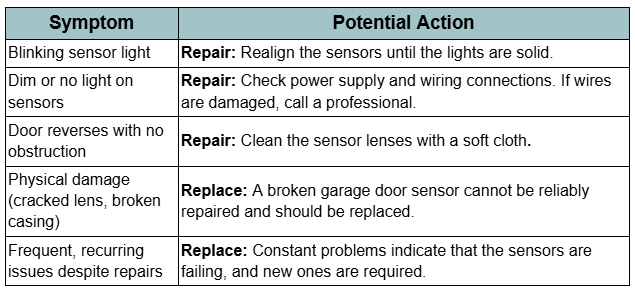
When to Repair Garage Door Sensor vs. Replace It for Optimal Performance
When a garage door sensor stops working correctly, the primary question is whether the issue requires a repair or a complete replacement. Many common problems, such as misaligned photo eyes, dirty lenses, or minor wiring concerns, can often be corrected without needing new parts. These situations typically involve restoring proper alignment or clearing the infrared pathway so the system can read signals correctly.
However, a sensor that no longer functions, has extensive wear from years of sun exposure, or frequently malfunctions, is often better replaced. Older sensors can lose accuracy, which affects the overall performance of the garage door system. When simple troubleshooting fails to restore regular operation, switching to a new sensor is the most dependable choice for consistent safety and reliable door movement.
This table can help you decide:
Selecting and Integrating Smart Garage Door Sensors into Modern Homes
Selecting the right smart garage door sensor is crucial for ensuring reliable performance in any modern home. Many newer garage door installation setups already include advanced functions, while older systems can be upgraded with smart sensor kits. It is essential to verify that the sensor is compatible with your current opener and functions with your smart home platform. Various sensor options are available online, but not all brands offer the same level of reliability. Consulting with a trusted garage door service provider can help you identify a sensor that suits your system and supports the features you desire.
Integrating a sensor into your garage door system should be handled with care to prevent alignment issues, wiring concerns, or network problems. When trained garage door service specialists complete the installation, all parts are aligned correctly, the wiring remains secure, and the sensor links smoothly with your network and mobile device. This careful setup ensures that safety functions activate properly and that your garage door system delivers dependable performance from the start.
Smart garage door sensors enhance home security by improving awareness, motion detection, and ensuring dependable daily operation. Their advanced functions support safer movement, protect your garage entry, and link smoothly with modern smart home systems. With steady alerts and consistent monitoring, these sensors help maintain a secure environment, providing a stronger sense of confidence every time the door opens.
At Aloha Garage Doors, we deliver trusted garage door solutions designed to support reliable safety and smooth performance. Our team can guide you in selecting the right smart sensor for your system and ensure everything functions without interruption. For more details or to schedule service, contact us or call us today. We are ready to help you strengthen your home’s protection with dependable smart garage door features.
Frequently Asked Questions
How do I know if my garage door sensor needs to be replaced?
A sensor may need replacement when there is visible wear, the indicator lights stay off even with proper power, or when repeated attempts to clean lenses and correct alignment do not restore function. Frequent malfunctions or irregular detections often mean the sensor can no longer read signals accurately, making a new sensor a safer option.
What should I do if my garage door sensor LED is off or flickering?
If the LED is off, confirm that the opener is receiving power. Flickering lights usually mean the photo eyes are not aligned. Gently adjust them until both indicators stay steady. Dust or debris on the lenses can also interrupt the beam, so cleaning the lenses can help restore proper signal flow.
How do I troubleshoot garage door sensors that aren’t working?
Start by clearing any objects blocking the infrared beam. Wipe the lenses to keep the pathway unobstructed. Then confirm the photo eyes are level with each other and the indicator lights remain steady. If wiring shows signs of wear or the sensor still fails to respond, service may be necessary to restore function.
What are the steps to repair a malfunctioning garage door safety sensor?
Begin by cleaning the lenses to restore beam clarity. Next, adjust the brackets until the photo eyes face each other evenly and the indicators stay steady. Inspect the wiring for looseness or visible signs of wear. If the door still refuses to close properly after these steps, service assistance is the next best option.
What types of replacement safety sensors are available for garage doors?
Replacement sensors come in several forms. Photoelectric sensors rely on infrared beams to detect obstructions. Mechanical sensors respond to physical contact with an object. Wireless sensors provide flexible placement options for various garage layouts. Smart sensor models can connect to home apps for alerts and remote monitoring, adding stronger security functions.
How do garage door safety sensors actually work?
Photo eyes create an invisible infrared beam across the garage opening. One unit sends the beam while the other receives it. When something breaks the beam as the door lowers, the receiving unit signals the opener to stop and reverse, preventing contact with anything in the door’s path.
What are common signs of garage door sensor failure?
Warning signs include the door refusing to close, reversing immediately after starting to lower, or sensor lights blinking or turning off. These symptoms may point to misalignment, lens obstruction, wiring faults, or internal sensor failure. When these issues continue, maintenance or repair may be needed.
What is the purpose of the garage door sensor?
The primary function of a garage door sensor is to prevent the door from lowering onto anything in its path. By detecting movement or an obstruction, the sensor triggers the opener to stop and reverse, protecting pets, belongings, and the door system itself.
Which sensor is ideal for safety systems in garages?
Photoelectric sensors, commonly referred to as photoeyes, are the standard safety sensors for modern garage doors. They offer consistent detection and support safer door movement. Smart photo-eye models can add features such as remote monitoring, alerts, and compatibility with home apps for stronger overall security.
How long do garage door safety sensors typically last before needing replacement?
Most garage door safety sensors last 8–12 years, depending on usage, climate conditions, and maintenance habits. Exposure to moisture, direct sunlight, or frequent alignment issues can shorten their lifespan. Regularly cleaning the lenses, ensuring proper alignment, and inspecting wiring can help extend sensor performance. If your door frequently reverses without an obstruction or the sensor lights stay inconsistent, it may be time to replace the sensors to maintain safe and reliable operation.
A sensor may need replacement when there is visible wear, the indicator lights stay off even with proper power, or when repeated attempts to clean lenses and correct alignment do not restore function. Frequent malfunctions or irregular detections often mean the sensor can no longer read signals accurately, making a new sensor a safer option.
If the LED is off, confirm that the opener is receiving power. Flickering lights usually mean the photo eyes are not aligned. Gently adjust them until both indicators stay steady. Dust or debris on the lenses can also interrupt the beam, so cleaning the lenses can help restore proper signal flow.
Start by clearing any objects blocking the infrared beam. Wipe the lenses to keep the pathway unobstructed. Then confirm the photo eyes are level with each other and the indicator lights remain steady. If wiring shows signs of wear or the sensor still fails to respond, service may be necessary to restore function.
Begin by cleaning the lenses to restore beam clarity. Next, adjust the brackets until the photo eyes face each other evenly and the indicators stay steady. Inspect the wiring for looseness or visible signs of wear. If the door still refuses to close properly after these steps, service assistance is the next best option.
Replacement sensors come in several forms. Photoelectric sensors rely on infrared beams to detect obstructions. Mechanical sensors respond to physical contact with an object. Wireless sensors provide flexible placement options for various garage layouts. Smart sensor models can connect to home apps for alerts and remote monitoring, adding stronger security functions.
Photo eyes create an invisible infrared beam across the garage opening. One unit sends the beam while the other receives it. When something breaks the beam as the door lowers, the receiving unit signals the opener to stop and reverse, preventing contact with anything in the door’s path.
Warning signs include the door refusing to close, reversing immediately after starting to lower, or sensor lights blinking or turning off. These symptoms may point to misalignment, lens obstruction, wiring faults, or internal sensor failure. When these issues continue, maintenance or repair may be needed.
The primary function of a garage door sensor is to prevent the door from lowering onto anything in its path. By detecting movement or an obstruction, the sensor triggers the opener to stop and reverse, protecting pets, belongings, and the door system itself.
Photoelectric sensors, commonly referred to as photoeyes, are the standard safety sensors for modern garage doors. They offer consistent detection and support safer door movement. Smart photo-eye models can add features such as remote monitoring, alerts, and compatibility with home apps for stronger overall security.
Most garage door safety sensors last 8–12 years, depending on usage, climate conditions, and maintenance habits. Exposure to moisture, direct sunlight, or frequent alignment issues can shorten their lifespan. Regularly cleaning the lenses, ensuring proper alignment, and inspecting wiring can help extend sensor performance. If your door frequently reverses without an obstruction or the sensor lights stay inconsistent, it may be time to replace the sensors to maintain safe and reliable operation.