Table of Contents
For any business in New Hampshire, a commercial door is more than a simple entry point, since it supports the rhythm of daily operations, shapes first impressions, and helps protect the people and property inside. When a door starts acting up, it can look minor at first, even though the impact often runs deeper than expected. A delay in addressing the issue can leave your business exposed to security threats, unexpected slowdowns, and disruptions that ripple through your workflow, especially when the door is tied to customer access or staff movement.
Most commercial door problems give warning signs before they become serious, whether it is visible damage, unfamiliar noises, or movement that feels rough, uneven, or unreliable. Paying attention to these signals matters because small faults tend to grow into larger risks when they are ignored, which is why many businesses turn to commercial garage door services as soon as performance starts to slip. By understanding why timely commercial door repair is essential, you reduce avoidable hazards, protect day-to-day activity, and keep your team and customers safer in the spaces you manage.
Why Commercial Door Repair Is a Business-Critical Concern
Choosing support for your commercial doors is not a small decision, because a dependable entryway influences safety, workflow, and the way customers judge your business before they ever step inside. When door problems are left unattended, the message can come across as carelessness, which can quietly erode trust with commercial clients and everyday visitors alike. Over time, that kind of impression affects more than appearances, since it can lead to lost opportunities and weaker revenue.
Handling commercial door repair promptly helps protect both your property and the people who rely on it, especially when minor issues are allowed to compound into failures that interrupt business or create unsafe conditions. A door that sticks, drags, or hesitates may look manageable in the moment, yet the risk rises quickly once parts wear further or alignment shifts. That is why it matters to understand how repairs connect to real business outcomes, because well-timed attention reduces hazards and keeps operations steady.
For more on early clues, read Commercial Door Repair Warning Signs Business Owners Often Miss.
How Commercial Door Repair Protects Safety and Security
A commercial door is one of the first lines of defense for your building, but it can only do its job when it closes, seals, and locks as it was designed to. The moment a door no longer sits properly or fails to secure, you create an opening for break-ins or vandalism, which becomes even more serious if the entrance is tied to access controls that depend on reliable door movement. In that situation, security systems lose much of their value, since a faulty door can override the protection you have in place.
Safety is just as tied to door performance as security is, because a door that jams, drops unexpectedly, or carries damaged hardware can injure employees and visitors without warning. Addressing problems early lowers these exposures, because a properly repaired door restores predictable movement and keeps your entry points working with the safety measures your building relies on. When commercial door repair happens on time, it helps prevent risks such as:
- Unauthorized entry after business hours
- Emergency exits that fail when they are needed most
- Injuries caused by sudden closing, sticking, or uneven movement
How Commercial Door Repair Supports Daily Operations
In busy commercial spaces, doors are part of the workflow itself, since retail entrances, warehouse bays, and loading dock doors all need to move smoothly for people and goods to pass through without delay. When a door drags or slows down, the effect is rarely isolated to that doorway, because deliveries back up, customers hesitate at the entrance, and staff lose time navigating a bottleneck that should not exist. What feels like a small mechanical change can turn into repeated interruptions across the day, especially in high-traffic environments.
Delays become more costly when the door fails at the wrong moment, because breakdowns tend to happen under stress and during peak use. A front entrance that sticks during opening hours or a loading door that refuses to lift during a delivery does more than create inconvenience, since it can stall schedules, strain teams, and damage the reliability your business is known for. Keeping doors in working order supports continuity and helps you avoid unplanned commercial door installation, because steady access allows the rest of your operation to run as it should without being forced into reactive downtime.
Common Issues That Trigger Commercial Door Repair in New Hampshire
Across New Hampshire, many businesses run into the same door problems, since harsh weather and constant use put commercial systems under steady strain. What often shows up first is a change in how the door feels or sounds, whether that is grinding during movement, resistance when opening, or visible wear along panels and hardware. These shifts usually point to mechanical trouble developing in the background, such as tracks drifting out of alignment or rollers wearing down faster than they should. When those early symptoms are left unaddressed, the door rarely stabilizes on its own, because everyday operation continues to push weakened parts toward failure.
As the damage builds, the risk shifts from inconvenience to disruption, because a door that moves unpredictably can slow work, compromise access, or stop functioning altogether. Understanding the patterns behind common door failures, including issues tied to overhead systems and garage-style entries, helps clarify why commercial door repair is so often needed in busy facilities. The more familiar these problems are, the easier it is to recognize when a door is shifting from normal wear into a condition that threatens daily operations.
For a deeper look at what delay can lead to, see How Delayed Commercial Door Repair Can Escalate Into Full Door Replacement.
Problems That Often Lead to Commercial Overhead Door Repair
Commercial overhead doors are built for tough environments, yet their moving parts carry more complexity than standard entry doors, which makes them vulnerable to specific breakdowns over time. In warehouse and industrial settings throughout New Hampshire, repeated heavy cycles wear down components quickly, so changes in movement or sound often signal the need for commercial overhead door repair. These issues can affect a wide range of overhead styles, from rolling steel systems to sectional aluminum doors, even when the door has been performing normally for years.
When overhead doors begin to struggle, the symptoms tend to be noticeable because they show up as loud noise, uneven motion, or sudden refusal to operate. The causes are usually tied to core hardware such as springs, cables, tracks, or motor assemblies, and the longer these parts operate in a weakened state, the higher the chance of a shutdown that interrupts the workday. To make the warning signs clearer, common symptoms often line up with underlying mechanical problems:
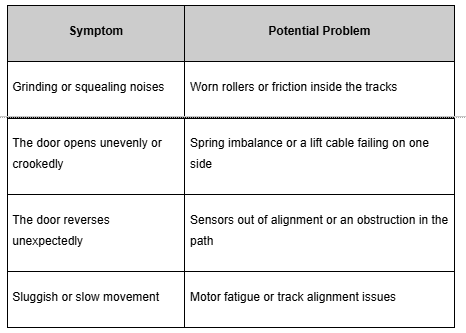
Warning Signs Behind Commercial Garage Door Repair Needs
With commercial garage-style doors, the first indicators of trouble are easy to dismiss because the system may still work even while the hardware starts to weaken. A delayed response from the opener can point to early motor or electrical strain, while a door that feels heavier than usual often reflects springs losing tension or cables beginning to wear. These changes tend to appear gradually, which is why they are often overlooked until performance drops more sharply.
Other warning signs show up directly on the door itself, such as frayed cables, rust spreading along panels, or tracks that look bent or uneven, and they often pair with early problems in commercial openers when the system starts to strain. As these conditions develop, the door becomes harder to operate safely and consistently, especially in spaces where traffic is frequent and timing matters.
In many facilities, the most common indicators connected to commercial garage door repair include:
- New or unusual sounds such as scraping, popping, or grinding during movement
- Visible damage like dents, cracks, or gaps forming around the door edges
- Slower operation or hesitation that was not present before
The Risks of Putting Off Commercial Door Repair
Delaying commercial door repair is a gamble that rarely pays off, because minor issues in a garage door or entry system tend to grow under daily use rather than settle down. What starts as a small change in movement or sound can spread to other components, since a struggling track, spring, or roller forces the rest of the system to work harder than it should. Once that chain reaction begins, doors often become unreliable at the worst possible time, leaving your business dealing with interruptions that are harder to control.
Security risks rise in the same way when repairs are postponed, especially if a door no longer closes or locks with full strength after hours. A weak or inconsistent seal makes entry points easier to exploit, which can turn an ordinary maintenance issue into a real safety concern overnight. Even when help is available quickly, emergency situations add pressure and chaos that most businesses would rather avoid, which is why staying ahead of commercial door repair is one of the simplest ways to prevent sudden downtime and avoidable disruption.
Learn more in Why Commercial Door Repair Matters for Security, Safety, and Daily Operations.
When Delays End in Commercial Door Replacement
There is a tipping point where postponed repairs stop being manageable and start pushing the door toward full replacement, usually when the core hardware fails in more than one place at the same time. A broken spring, for example, shifts extra strain onto the opener and lifting system, which can trigger additional breakdowns once the door keeps cycling under load. What could have been a single repair becomes a wider system failure, because the door is no longer operating as a balanced unit.
Severe structural damage can speed up that outcome, particularly when panels are bent beyond alignment or corrosion weakens the frame to the point where stability cannot be restored, even after multiple garage door repairs. Automatic systems follow the same pattern, since a total failure in the motor or control board can make the door unsafe or impossible to operate reliably, especially if the surrounding hardware has already worn down. At that stage, commercial door replacement is no longer a choice made for convenience, but a necessity created by earlier delays that left no safe path back to dependable operation.
How Unresolved Commercial Door Repair Creates Business Disruption
A failing door is not a small issue in a commercial space, because it can slow or even stop the flow of customers, staff, and deliveries that your business depends on. When an entry or loading door won’t work properly, operations suffer fast, since access gets blocked, schedules slip, and people are forced to work around the problem. In New Hampshire, where many facilities rely on high-use doors every day, timely commercial door repair helps keep business moving without disruption.
When commercial doors are not kept in good working order, the effects reach far beyond the doorway, since safety, security, and daily operations all depend on reliable access. If warning signs start to show up, acting quickly matters because small faults tend to widen into larger failures once wear and stress build up over time. By understanding what can happen when repairs are delayed, you put your business in a stronger position to avoid disruption and protect the people who move through your space every day.
For businesses that want dependable support without the headaches of recurring door issues, Aloha Garage Doors offers a steady, business-focused approach that keeps commercial entryways and overhead systems working the way they should. Whether you manage a storefront, a warehouse, or a busy facility with constant traffic, having a team that understands how commercial doors affect your workflow can make all the difference when reliability matters most. Contact us today or give us a call to schedule an assessment and keep your doors operating with confidence.
Frequently Asked Questions
What are the biggest risks of delaying commercial door repair in a busy business setting?
Delays in commercial door repair raise security risk and disrupt daily flow, because small faults often grow into breakdowns that cause downtime and bigger system strain.
How can commercial door repair problems affect building security and workplace safety?
Commercial door repair problems can leave doors unable to lock or close correctly, while unstable movement increases injury risk for anyone using the entry.
What are the most common causes behind recurring commercial door repair issues in high-traffic facilities?
Recurring commercial door repair issues usually come from heavy cycling, gradual misalignment, and repeated impacts, since constant use wears key parts faster.
What types of damage or wear usually lead to commercial door repair requests?
Commercial door repair is often triggered by dents, rust, frayed cables, worn rollers, or off-track movement, because each of these issues weakens the door’s structure and throws its mechanics out of balance, especially when core parts like the springs begin to fail over time, as explained by Wikipedia.
Which commercial door types are most often addressed through commercial door repair?
Commercial door repair commonly involves overhead doors, automatic entry doors, rolling doors, fire-rated doors, and glass storefront doors, since all face high-use stress.
When does commercial door repair for automatic systems turn into commercial door replacement?
Commercial door repair turns into commercial door replacement when the motor or control system fails completely, or the door structure is too compromised to stay stable.
Why do loading entrances sometimes require commercial overhead door repair more often?
Loading zones need commercial overhead door repair more often because doors cycle constantly and take heavier impacts from equipment and deliveries.
What does it mean when a warehouse entrance suddenly needs commercial garage door repair?
A sudden need for commercial garage door repair usually signals a failed spring or cable, because those parts carry the door’s weight and balance.
Why might commercial door repair be needed after water seeps under an entry door?
Commercial door repair may be needed after water intrusion because moisture promotes corrosion and warping that weaken materials and distort the door’s fit, which then undermines sealing and alignment, as noted by Penn State Extension.
What causes commercial overhead door repair issues like hesitation or uneven movement?
Commercial overhead door repair issues like hesitation or uneven travel usually come from spring imbalance, cable wear, or track and roller friction.
Delays in commercial door repair raise security risk and disrupt daily flow, because small faults often grow into breakdowns that cause downtime and bigger system strain.
Commercial door repair problems can leave doors unable to lock or close correctly, while unstable movement increases injury risk for anyone using the entry.
Recurring commercial door repair issues usually come from heavy cycling, gradual misalignment, and repeated impacts, since constant use wears key parts faster.
Commercial door repair is often triggered by dents, rust, frayed cables, worn rollers, or off-track movement, because each of these issues weakens the door’s structure and throws its mechanics out of balance, especially when core parts like the springs begin to fail over time, as explained by Wikipedia.
Commercial door repair commonly involves overhead doors, automatic entry doors, rolling doors, fire-rated doors, and glass storefront doors, since all face high-use stress.
Commercial door repair turns into commercial door replacement when the motor or control system fails completely, or the door structure is too compromised to stay stable.
Loading zones need commercial overhead door repair more often because doors cycle constantly and take heavier impacts from equipment and deliveries.
A sudden need for commercial garage door repair usually signals a failed spring or cable, because those parts carry the door’s weight and balance.
Commercial door repair may be needed after water intrusion because moisture promotes corrosion and warping that weaken materials and distort the door’s fit, which then undermines sealing and alignment, as noted by Penn State Extension.
Commercial overhead door repair issues like hesitation or uneven travel usually come from spring imbalance, cable wear, or track and roller friction.