Table of Contents
Your commercial door is more than a simple entry point for people coming and going. It supports the safety and day-to-day flow of your business, especially across commercial spaces in New Hampshire, where reliable access keeps goods, customers, and staff moving without friction. Because early problems often develop quietly, they can be easy to overlook while you are focused on everything else that needs your attention.
When those small issues go unchecked, the door can fail without warning and create safety risks or interrupt operations at the worst possible time. You protect your investment and keep your site running smoothly when you understand what changes to take seriously, even if they seem minor at first. Commercial door repair services and commercial garage door services can step in before the situation escalates, once the signs are clear enough that you know it is time to call.
Commercial Door Repair Warning Signs Business Owners Often Miss
Many commercial door problems begin as small changes that feel easy to dismiss, especially when the day is already packed. A faint grinding sound, a door that hesitates mid-movement, or a latch that no longer pulls tight can look like minor annoyances, yet those early shifts often point to mechanical wear building underneath. What starts with subtle friction or uneven travel can develop into issues like degraded rollers, warped tracks, or struggling openers, once the strain has had time to spread through the system.
For business owners across New Hampshire, the key is recognizing that doors rarely fail out of nowhere. Small irregularities tend to grow into serious disruptions that can force urgent repairs or even push a door toward full replacement when they are allowed to compound unnoticed. Treating early changes as meaningful signals helps protect security and keeps operations steady, especially when professional support steps in before the damage becomes structural.
For more context, check out “Why Ignoring Commercial Door Repair Puts Your Business at Risk.”
Commercial Door Repair Indicators Seen in Frame or Hinge Misalignment
A door that slips out of alignment is one of the clearest warning signs of trouble, even though it often goes unnoticed in a busy space. When the slab sits crooked, or when gaps appear uneven along the top, sides, or threshold, the frame and hinges are no longer carrying weight the way they should. As that imbalance grows, the door may scrape the floor, bind against the jamb, or resist closing cleanly, creating stress that spreads into every moving part while weakening the entry point itself.
Misalignment can come from natural building shifts, repeated impact, or years of heavy daily use, and the consequences reach beyond simple inconvenience. Locks may stop lining up correctly, so the bolt no longer seats where it should, leaving the door easier to defeat than it looks at a glance. At the same time, those uneven gaps invite air, dust, and moisture inside, which can make the interior harder to control and leave the opening more exposed, once the door is no longer sealing as intended.
Commercial Door Repair Concerns Behind Increasing Door Resistance
When a commercial door that once moved smoothly begins to require more force, that change in resistance is rarely harmless. The extra effort indicates that something in the system is no longer operating in balance, and pushing through it only magnifies strain on rollers, tracks, hinges, and automatic components, until the door fails outright. What feels like a small shift in how the door handles can be the first step toward a breakdown that interrupts access and creates avoidable risk, and may even lead to the need for commercial door installation if the system can no longer be restored safely once the warning goes unchecked.
Resistance usually comes from friction or imbalance developing inside the door assembly, which often traces back to one or more of these issues:
- Worn or weakened springs that no longer support the door’s weight the way they should
- Bent, misaligned, or obstructed tracks that prevent rollers from traveling cleanly
- Automatic opener strain or motor fatigue that causes the system to struggle under load
- Increasing internal friction in moving components as wear builds and parts begin rubbing instead of gliding
Security and Operational Risks That Can Trigger Commercial Door Replacement
When commercial door problems are ignored, they tend to grow from minor inconveniences into genuine security liabilities and operational disruptions. A door that no longer locks as it should, or one that has suffered visible structural damage, creates openings for theft and vandalism that most businesses cannot afford to risk. Once the condition of the door slips beyond a safe repair threshold, replacement becomes less of a preference and more of a responsible path, because a compromised entry point cannot do its job, no matter how many temporary fixes are applied.
Ongoing door failures also have a way of eroding day-to-day reliability until normal operations start bending around the problem. While many routine mechanical issues can be resolved through professional repair, damage to essential components such as panels, motors, or sensor systems can push a door into the category where replacement is the only sensible way forward. Especially when modern access control is involved, pairing new security systems with a door that cannot align, seal, or operate consistently usually leads to more frustration than assurance, which is why the breakdown patterns below are often the turning point toward replacement.
For a deeper look, read “How Delayed Commercial Door Repair Can Escalate Into Full Door Replacement.”
Lock Reliability Breakdowns That Accelerate Commercial Door Replacement Needs
The security of a commercial facility depends heavily on a lock that engages smoothly and holds firmly, so repeated lock failures should never be treated as a minor nuisance. You may notice keys sticking, deadbolts refusing to seat cleanly, or electronic entry systems that work only some of the time, and while certain lock issues can be corrected, persistent failures often point to a deeper problem. When the same lock troubles keep returning, it is frequently because the door itself is no longer stable enough to support secure hardware, even if the lock is repaired or replaced.
A lock cannot perform properly when the door is bent, sagging, or sitting out of alignment, since uneven pressure wears components down and prevents consistent engagement. If the panel around the locking area is cracked or weakened, the issue becomes structural rather than mechanical, and new hardware will not restore real security for long. In those cases, repair attempts may buy short-term function, yet they cannot return the door to the solid condition that reliable locking requires, which is why replacement becomes the safer option when the door is the root cause of failure.
When lock problems continue because the door has lost its integrity, commercial door replacement is the step that restores dependable protection. A new door brings proper alignment, stable hardware support, and compatibility with updated access control, so security is no longer hanging on a system that is fighting against worn structure. The result is a facility that locks the way it should, because the door once again provides the strong foundation that the lock depends on.
Workflow and Access Interruptions Linked to Unresolved Commercial Door Repair
Unresolved commercial door issues do more than slow traffic; they gradually reshape how a business functions day to day. A loading dock door that stalls halfway through operation can freeze deliveries and throw schedules off rhythm, while a main entry door that fails to open consistently creates friction for staff and visitors at the exact place where flow should be effortless. What begins as a momentary delay can turn into a recurring interruption that affects productivity, customer experience, and overall efficiency, because access is no longer dependable.
Inside the building, the effects spread further than most owners expect. Employees lose time wrestling with doors that stick or rerouting through secondary entrances, and when emergency exits or restricted access doors begin failing, the inconvenience crosses into safety risk. If these disruptions become routine, they start wearing down morale and forcing management to compensate for a problem that should not exist, which is why replacement often becomes necessary after too many cycles of breakdown and temporary recovery.
That is why commercial door repairs matter as early as the first signs of disruption. When issues are addressed before they become embedded in daily workflow, the business keeps moving the way it was designed to move, without access delays undermining the routine. A reliable commercial door system supports smooth operations and secure entry, with commercial openers working as intended so the door moves with your business rather than against it.
Commercial Garage Door Repair and Commercial Overhead Door Repair Issues in Kingston, NH
Across Kingston, NH, and the wider southern New Hampshire area, commercial garage doors and overhead doors carry a heavy workload every day. Because they open and close far more often than most owners realize, wear shows up in ways that are specific to commercial settings and usually requires skilled attention once the strain starts building. The upside is that commercial garage door repair and commercial overhead door repair in this region are built around those exact demands, since these systems are common in local facilities.
Whether the door is high-speed equipment in a warehouse or a sectional system at an auto repair shop, the underlying goal is the same: keep access reliable and security intact while minimizing downtime. When something feels off, local technicians can diagnose the cause quickly and restore safe operation before the issue spreads into a larger system failure. Below are the kinds of problems that often appear in heavy-duty New Hampshire commercial doors, especially where traffic and daily cycling are constant.
For more insight, see “Why Commercial Door Repair Matters for Security, Safety, and Daily Operations.”
Commercial Garage Door Repair Problems in Heavy-Use Door Types
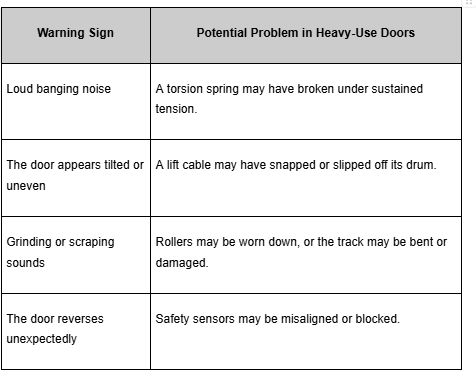
Heavy-use doors in warehouses, distribution centers, and manufacturing sites absorb a level of operational stress that pushes components to their limits. Since these doors are larger, heavier, and cycled hundreds of times per day, parts like springs, cables, rollers, and motors wear out faster than in lighter-duty systems, increasing the likelihood of failure once fatigue sets in. What begins as a slight change in movement or sound can turn into a serious reliability issue, because the door is working under load again and again.
Among the most common breakdowns are torsion springs that snap under constant tension, cables that fray or slip and leave the door unbalanced, and tracks or rollers that deform after repeated impact from equipment. When alignment drifts or hardware weakens, the door may hesitate, grind, or shift unevenly during travel, which signals that the system is no longer carrying its weight correctly. These conditions are not just inconvenient; they can become dangerous to staff and property when the door finally gives way. That’s why calling a commercial garage door repair professional for prompt garage door repairs as soon as the warning signs appear is the safest move.
When you need dependable commercial door repair in New Hampshire, Aloha Garage Doors is a trusted local team that understands how fast small door problems can turn into bigger business risks. Our technicians handle commercial doors with the urgency and precision busy facilities require, helping you restore safe access and steady operations without the guesswork. Contact us today or give us a call to schedule an inspection or request service, and keep your doors working the way your business needs them to.
Frequently Asked Questions
What warning signs show that commercial door repair is needed?
Commercial door repair is usually needed when the door starts grinding or squeaking, feels harder to open or close, shows dents or cracks, or sits unevenly in the frame. These signs often begin quietly but point to mechanical stress that worsens with daily use, which is why service should be scheduled once they appear.
Do commercial door repair providers in Kingston, NH, handle urgent situations?
Yes, urgent commercial door repair is commonly available in Kingston, NH when a door failure puts security or access at risk. Technicians typically respond to doors stuck open or shut, off-track movement, and locking failures, restoring safe operation as quickly as conditions require.
What kinds of commercial doors are typically covered by commercial door repair?
Commercial door repair generally covers sectional overhead doors, rolling steel doors, fire-rated doors, high-speed doors, storefront glass doors, and many automatic entry systems. Most commercial door types can be evaluated and serviced, depending on their structure and operating hardware.
What are the most common problems that lead to commercial door repair calls?
The most common reasons for commercial door repair include broken springs, damaged cables, opener trouble, misaligned tracks, worn rollers, and failing door closers, all of which can disrupt operation or sealing until daily use pushes the system toward a larger failure. Because door performance also affects safe access and required opening force, guidance from the ADA National Network helps clarify why doors that drag, resist, or close unpredictably should be addressed before the strain spreads through the hardware.
Can automated systems be fixed with commercial overhead door repair, or is commercial door replacement required?
Automated systems are often restored through commercial overhead door repair when the issue is tied to sensors, wiring, or opener components. Commercial door replacement becomes the practical choice when core parts are severely damaged or the system can no longer operate reliably.
What does a crooked or uneven door reveal about the need for commercial door repair?
A crooked or uneven door usually signals frame shift, hinge wear, or cable imbalance, which prevents smooth travel and stable locking. Because misalignment puts constant pressure on the system, commercial door repair is needed before additional parts fail.
Why does a door become hard to open or close, prompting commercial door repair?
When a door becomes difficult to move, resistance is building from worn springs, bent tracks, damaged rollers, or an overworked motor. The harder the door fights normal use, the more likely the system is heading toward breakdown, which is why repair is required once that change is noticeable.
What causes drafts or air leaks that often result in commercial door replacement?
Drafts usually come from worn seals or a door that no longer fits the frame cleanly due to warping or structural drift. When sealing problems trace back to door damage rather than hardware wear, commercial door replacement may be necessary to restore a tight, secure closure.
Why does water seep under some doors, leading to commercial door repair concerns?
Water seepage typically points to a failing bottom seal, frame misalignment, or an uneven threshold that leaves a path for runoff, especially once the door can no longer seal the opening the way it was designed to. Because moisture intrusion can damage flooring and inventory and spread deeper into the entry system over time, commercial door repair should address the root cause early, as guidance on sealing and weather protection from the Department of Energy reinforces.
What does hesitation or intermittent motion suggest about commercial garage door repair needs?
Stop-and-go movement in an automatic door usually indicates opener strain, electrical faults, motor wear, or sensor interference. When the operation becomes inconsistent, commercial garage door repair is needed to restore safe, predictable cycling.
Commercial door repair is usually needed when the door starts grinding or squeaking, feels harder to open or close, shows dents or cracks, or sits unevenly in the frame. These signs often begin quietly but point to mechanical stress that worsens with daily use, which is why service should be scheduled once they appear.
Yes, urgent commercial door repair is commonly available in Kingston, NH when a door failure puts security or access at risk. Technicians typically respond to doors stuck open or shut, off-track movement, and locking failures, restoring safe operation as quickly as conditions require.
Commercial door repair generally covers sectional overhead doors, rolling steel doors, fire-rated doors, high-speed doors, storefront glass doors, and many automatic entry systems. Most commercial door types can be evaluated and serviced, depending on their structure and operating hardware.
The most common reasons for commercial door repair include broken springs, damaged cables, opener trouble, misaligned tracks, worn rollers, and failing door closers, all of which can disrupt operation or sealing until daily use pushes the system toward a larger failure. Because door performance also affects safe access and required opening force, guidance from the ADA National Network helps clarify why doors that drag, resist, or close unpredictably should be addressed before the strain spreads through the hardware.
Automated systems are often restored through commercial overhead door repair when the issue is tied to sensors, wiring, or opener components. Commercial door replacement becomes the practical choice when core parts are severely damaged or the system can no longer operate reliably.
A crooked or uneven door usually signals frame shift, hinge wear, or cable imbalance, which prevents smooth travel and stable locking. Because misalignment puts constant pressure on the system, commercial door repair is needed before additional parts fail.
When a door becomes difficult to move, resistance is building from worn springs, bent tracks, damaged rollers, or an overworked motor. The harder the door fights normal use, the more likely the system is heading toward breakdown, which is why repair is required once that change is noticeable.
Drafts usually come from worn seals or a door that no longer fits the frame cleanly due to warping or structural drift. When sealing problems trace back to door damage rather than hardware wear, commercial door replacement may be necessary to restore a tight, secure closure.
Water seepage typically points to a failing bottom seal, frame misalignment, or an uneven threshold that leaves a path for runoff, especially once the door can no longer seal the opening the way it was designed to. Because moisture intrusion can damage flooring and inventory and spread deeper into the entry system over time, commercial door repair should address the root cause early, as guidance on sealing and weather protection from the Department of Energy reinforces.
Stop-and-go movement in an automatic door usually indicates opener strain, electrical faults, motor wear, or sensor interference. When the operation becomes inconsistent, commercial garage door repair is needed to restore safe, predictable cycling.