Table of Contents
The doors at your commercial property are more than simple entry points, since they support daily operations, protect the building, and shape how safe the space feels for everyone who walks through it. When commercial door issues show up at a New Hampshire business, it can be tempting to delay repairs because it seems like the easiest way to avoid disruption or keep costs down in the moment. That hesitation is understandable, even though the short-term convenience rarely matches the long-term outcome once the door continues to operate under strain.
Small problems rarely stay small, especially when a door is used constantly throughout the day, because wear spreads from one component to the next until the entire system is affected. What starts as a minor issue can quietly turn into a failure that slows customers, risks security, or interrupts operations at the worst time, which is why acting early matters more than it first appears and why many businesses turn to commercial garage door services before damage escalates. When repairs are pushed aside for too long, the damage often reaches a point where a simple fix is no longer enough, leaving full replacement as the only practical option.
Consequences of Delaying Commercial Door Repair
Delaying commercial door repair can feel like a harmless short-term decision, especially when the issue seems minor or easy to work around. A door that drags, resists closing, or starts making unfamiliar sounds is not just being inconvenient, since those changes usually signal stress inside the system that will not resolve on its own. Each time the door is used in that condition, strain spreads to connected parts and accelerates wear in places you may not notice right away, which is how a manageable repair often grows into a larger and more expensive problem later on.
What makes delay so risky is that the impact is rarely limited to the door itself, because safety, security, and daily operations depend on it working correctly. A situation that could have been corrected early can become disruptive at the worst possible moment, pushing the door past the point where repair is practical and leaving replacement as the only workable outcome. The longer a damaged door stays in service, the more likely it is that the repair window closes, since continued stress shortens the door’s lifespan and increases the scale of failure you have to address.
For more on the stakes, read “Why Ignoring Commercial Door Repair Puts Your Business at Risk.”
Safety Threats That Grow When Commercial Door Repair Is Put Off
A commercial door that is not functioning properly can become a safety hazard for employees, customers, and visitors, especially when heavy traffic or automated movement is involved. Even when doors are designed with protective features, those safeguards can fail when the system is misaligned or worn, which is why a door that closes too quickly, sticks mid-cycle, or stops responding as expected should be treated as a serious concern rather than a routine annoyance. The risk increases with continued use, since the door is operating outside normal tolerances and placing more force on components that are already compromised.
As repairs are delayed, small safety issues can turn into sudden failures, particularly when stressed parts are carrying loads or tensions they were not meant to handle long-term. Worn door closers can cause heavy doors to swing or slam unpredictably, while faulty or misaligned sensors on automatic systems may not detect movement in the opening, creating a dangerous situation for anyone passing through. The most severe incidents often trace back to parts that fail under pressure, because they can release force without warning.
Some safety hazards that can worsen when repairs are postponed include:
- Broken springs and cables, since these components support significant weight and can fail suddenly, allowing the door to drop or shift without control.
- Faulty automatic sensors, because a door that cannot detect an obstruction may close on a person or object.
- Malfunctioning closers can injure someone or violate safety expectations for the space when doors slam shut or refuse to close properly.
Security Risks That Escalate Without Timely Commercial Door Repair in Kingston, NH
A commercial door is one of the first and most important layers of security in any facility, because even the best access systems cannot compensate for a door that will not close, latch, or lock correctly. When that barrier weakens, it creates an opening for unauthorized entry and raises the risk of theft, damage, or exposure of sensitive areas, especially when the issue is visible to anyone approaching the property. What seems like a minor closing or locking problem can quickly become a broader vulnerability, since repeated failure makes the entrance easier to force or exploit.
For businesses in Kingston and throughout New Hampshire, these risks carry real operational consequences, because a compromised entry point can disrupt work, create liability, and invite incidents that are far more costly than the original repair. The longer the door is left in a weakened state, the more predictable the vulnerability becomes, which is why a delay often turns a controllable concern into an urgent security problem. Addressing the issue early protects more than the door itself, since it preserves the integrity of the building and reduces the chance of escalating damage that could ultimately require full replacement or even a complete commercial door installation.
How Minor Issues Become Commercial Door Replacement
A small door problem rarely stays isolated, because commercial doors work as connected systems where one weak point forces the rest to compensate. What begins as a squeak, a slight misalignment, or a latch that no longer closes cleanly often signals that the door is drifting out of tolerance, which makes hinges, tracks, and closing mechanisms work harder than they should. As that extra load repeats day after day, parts start to deform under pressure and wear spreads into areas that were never the original problem, which is how a minor fault can quietly move toward structural failure.
That chain reaction is why delays matter so much, since a single worn hinge can gradually pull the door off level and transfer stress into the frame, lock area, and closer. Over time, the door’s movement becomes less predictable and more forceful, and the surrounding structure begins to absorb the strain it was not designed to carry. When multiple components reach their limit at the same time, repair stops being a realistic option because the system is no longer failing in one place, but across the door as a whole.
For signs to watch before damage snowballs, check out “Commercial Door Repair Warning Signs Business Owners Often Miss.”
Early Damage Progression That Often Leads to Commercial Door Replacement
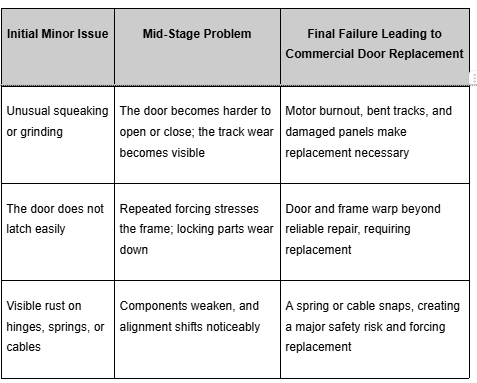
Commercial door issues tend to escalate in recognizable stages, even when they appear harmless at first, which is why early symptoms deserve attention. Misalignment, unusual noise, or resistance during operation are often the outward signs of internal wear, and when those signals are ignored, the door continues to run while deteriorating beneath the surface. In high-use facilities, that progression can accelerate faster than most owners expect because the door is cycling under strain.
To show how quickly this can happen, here’s a simple progression table:
Long-Term Strain That Makes Commercial Door Replacement Unavoidable
Using a commercial door in a damaged state creates a compounding effect because each cycle pushes stress through the door, the frame, and the hardware. Each time a misaligned door is forced shut, or an opener struggles through resistance, the system absorbs load in the wrong places, and that repeated strain slowly changes the door’s shape and stability. After months or years of operating under that pressure, the door can lose structural integrity in ways a simple repair can no longer restore, since the strength of the system has been fundamentally reduced.
Once prolonged strain begins to affect multiple load-bearing or operational components at the same time, including the hinges, tracks, and commercial openers that drive consistent movement, the door stops being a collection of fixable parts and becomes a compromised unit, which is when replacement shifts from a preference to a necessity. What makes this outcome so frustrating is that it often traces back to a minor issue that was allowed to keep spreading stress through the system until the door reached a point where repair could no longer return it to reliable operation.
Commercial Garage Door Repair and Commercial Overhead Door Repair Risks
Commercial garage doors and overhead doors carry a heavy workload in many facilities, and the scale of that work brings real risk when something starts to go wrong. Because these doors rely on a precise balance between springs, cables, tracks, and the opener, a failure in one area can quickly destabilize the rest of the system. When commercial garage door repair or commercial overhead door repair is delayed, the door keeps operating under uneven strain, which can cause sudden breakdowns that interrupt operations and create unsafe conditions in high-traffic areas.
In busy New Hampshire properties where doors cycle repeatedly throughout the day, wear builds faster than most people expect, especially when moving parts are already under load. As springs weaken, cables fray, or rollers lose alignment, the door begins to fight its own structure, and that resistance spreads damage from one component to the next. Once the system reaches that stage, failures often happen without much warning, which is why postponing service tends to lead to more disruptive outcomes than addressing the issue early.
For a deeper look at what’s at stake, read “Why Commercial Door Repair Matters for Security, Safety, and Daily Operations.”
Breakdown Patterns That Trigger Commercial Garage Door Repair Emergencies
Certain commercial garage door problems almost always escalate into emergency situations, since they can stop access immediately or create a safety hazard the moment they occur. A broken torsion spring is one of the clearest examples, because the spring carries the weight of the door and releases that force abruptly when it fails, often leaving the door extremely difficult or impossible to lift. Cable damage follows a similar pattern, since cables work in tandem with springs to guide the door evenly, and when one snaps or frays severely, the door can tilt in the tracks or drop unexpectedly as the balance disappears.
Automatic system failures can be just as disruptive, especially when sensors or openers stop responding mid-cycle, because a door that will not complete its movement can trap vehicles, block loading zones, or leave an entry unsecured, which is when garage door repairs become urgent rather than optional. These issues are not simply inconvenient once they reach this point, as they immediately create operational pressure and increase the risk of further damage if the door is forced further.
Key situations that commonly lead to emergency commercial garage door repair include:
- A loud snapping or banging noise, which often signals a spring failure and indicates the system has lost its counterbalance.
- A door that slips off its tracks, since instability increases quickly once alignment is lost and the door’s weight is no longer guided safely.
- A door that will not open or close at all, because a complete stoppage usually means a critical component has failed, and the system cannot function reliably.
Operational Failures Linked to Commercial Overhead Door Repair Delays
Delaying garage door repair in a commercial space can stall everyday operations, especially in warehouses, loading docks, and service bays where an overhead door keeps traffic moving. When the door sticks, won’t seal, or stops responding, shipping slows, vehicles get trapped, and work backs up, while exposure to outside conditions can threaten inventory and strain the facility. The longer the issue lingers, the more disruption spreads into schedules, safety, and security, leaving your business to absorb bigger setbacks than the repair ever would have caused.
Every business owner should understand what’s at stake when commercial door problems are left unresolved, because small issues that seem harmless at first can grow into serious safety and security risks that endanger people, property, and daily operations. What starts as minor wear or misalignment can worsen with constant use, eventually forcing far more extensive repairs or even full replacement once the damage spreads through the system. Acting early keeps your doors reliable and your business running without avoidable disruption, since timely attention prevents small faults from turning into costly setbacks. If you’re unsure whether your doors are still operating as they should, having them evaluated sooner rather than later helps protect your workplace and maintain smooth, secure access.
When you need dependable help to keep those risks from escalating, Aloha Garage Doors is the team businesses trust for clear assessments and practical repair solutions that restore safe, reliable performance. Our experience with commercial doors means problems get identified before they spiral into replacements, helping your operation stay secure and uninterrupted. Contact us today or give us a call to schedule a professional evaluation and get your doors back on track.
Frequently Asked Questions
How do you tell whether commercial door repair is still possible or if commercial door replacement is necessary?
Commercial door repair is usually enough when damage is limited to a specific part and the door structure is still sound, such as a closer, hinge, or lock that has worn out. Commercial door replacement becomes the better path when the frame is compromised, panels are warped, or rust and fatigue have spread through multiple components, since restoring safe operation is no longer reliable once the core structure has weakened.
Can automated commercial doors undergo commercial door repair, or does damage usually lead to commercial door replacement?
Automated doors can often be restored through commercial door repair because most failures come from sensors, operators, or control components that can be replaced without disturbing the entire door system. Replacement is typically the right call when the door has major structural damage or the automation platform has degraded beyond stable function, especially when repeated failures show the system can’t maintain consistent performance.
What risks increase when a business delays commercial door repair for too long?
Delays raise security risk first, since doors that don’t latch or lock properly leave openings for unauthorized access. Safety risk follows closely when doors start moving unpredictably or failing under load, while operational disruption grows as worn parts spread stress through the system, which is how a minor fault often turns into a shutdown-level failure.
What are the most common issues that require commercial door repair in commercial properties?
The most common commercial door repair needs are misalignment, worn hinges, failing closers, and damaged frames, all of which can lead to sticking, dragging, or uneven closing once the door starts fighting its own alignment. When a closer begins to fail, the door may slam, drift, or refuse to latch properly, which makes it important to understand how these mechanisms should behave, as explained by the ADA National Network, so problems are easier to spot early. In automated systems, sensor faults and operator wear often cause inconsistent movement or incomplete cycles, while glass or panel doors are more likely to develop cracks or bending after long-term use, which gradually weakens the structure as day-to-day stress accumulates.
What types of commercial doors can be handled through commercial door repair in business locations?
Commercial door repair applies to most door types used in business properties, including swinging entry doors, automatic pedestrian doors, roll-up and steel service doors, fire-rated doors, and commercial garage systems. The deciding factor is not the door type but the condition of its structure, since repair remains viable when the main frame and panels are still intact.
How can delayed commercial garage door repair disrupt daily business operations?
Delayed commercial garage door repair can stall loading, shipping, and vehicle flow when doors jam, drift off track, or stop responding to their operators. Disruption spreads fast once access points become unreliable, because a single overhead opening often supports multiple workflows tied to timing and security.
What causes problems that lead to commercial overhead door repair in busy facilities?
Commercial overhead door repair is most often triggered by high cycle volume that wears down springs, cables, rollers, and tracks over time. In facilities with constant traffic and shifting weather exposure, system balance can degrade faster than expected, especially once alignment or tension starts to drift.
What does it mean when commercial doors start sitting crooked and may need commercial door repair?
A door that sits crooked usually points to misalignment caused by hinge failure, frame distortion, or track wear, which prevents the door from sealing or locking correctly. The longer that the uneven load continues, the more stress it pushes into nearby components, making commercial door repair more urgent once the door starts leaning out of square.
Why can a commercial door become a struggle to operate, prompting commercial door repair?
Operation becomes difficult when alignment slips or hardware wears down, since the door starts rubbing, dragging, or pushing back against the closer and latch system instead of moving cleanly through its cycle. As resistance builds with repeated strain, hinges, rollers, and related components deteriorate faster, which is why commercial door repair becomes necessary once smooth operation is no longer consistent, as also explained by InterNACHI.
How do drafts, gaps, or water seepage around entryways signal the need for commercial door repair or commercial door replacement?
These signs show the door is no longer sealing properly, often because alignment has shifted or the frame and threshold have worn unevenly. Commercial door repair can restore the seal when the structure is still true, but commercial door replacement is typically required once warping or frame damage prevents a tight close.
Commercial door repair is usually enough when damage is limited to a specific part and the door structure is still sound, such as a closer, hinge, or lock that has worn out. Commercial door replacement becomes the better path when the frame is compromised, panels are warped, or rust and fatigue have spread through multiple components, since restoring safe operation is no longer reliable once the core structure has weakened.
Automated doors can often be restored through commercial door repair because most failures come from sensors, operators, or control components that can be replaced without disturbing the entire door system. Replacement is typically the right call when the door has major structural damage or the automation platform has degraded beyond stable function, especially when repeated failures show the system can’t maintain consistent performance.
Delays raise security risk first, since doors that don’t latch or lock properly leave openings for unauthorized access. Safety risk follows closely when doors start moving unpredictably or failing under load, while operational disruption grows as worn parts spread stress through the system, which is how a minor fault often turns into a shutdown-level failure.
The most common commercial door repair needs are misalignment, worn hinges, failing closers, and damaged frames, all of which can lead to sticking, dragging, or uneven closing once the door starts fighting its own alignment. When a closer begins to fail, the door may slam, drift, or refuse to latch properly, which makes it important to understand how these mechanisms should behave, as explained by the ADA National Network, so problems are easier to spot early. In automated systems, sensor faults and operator wear often cause inconsistent movement or incomplete cycles, while glass or panel doors are more likely to develop cracks or bending after long-term use, which gradually weakens the structure as day-to-day stress accumulates.
Commercial door repair applies to most door types used in business properties, including swinging entry doors, automatic pedestrian doors, roll-up and steel service doors, fire-rated doors, and commercial garage systems. The deciding factor is not the door type but the condition of its structure, since repair remains viable when the main frame and panels are still intact.
Delayed commercial garage door repair can stall loading, shipping, and vehicle flow when doors jam, drift off track, or stop responding to their operators. Disruption spreads fast once access points become unreliable, because a single overhead opening often supports multiple workflows tied to timing and security.
Commercial overhead door repair is most often triggered by high cycle volume that wears down springs, cables, rollers, and tracks over time. In facilities with constant traffic and shifting weather exposure, system balance can degrade faster than expected, especially once alignment or tension starts to drift.
A door that sits crooked usually points to misalignment caused by hinge failure, frame distortion, or track wear, which prevents the door from sealing or locking correctly. The longer that the uneven load continues, the more stress it pushes into nearby components, making commercial door repair more urgent once the door starts leaning out of square.
Operation becomes difficult when alignment slips or hardware wears down, since the door starts rubbing, dragging, or pushing back against the closer and latch system instead of moving cleanly through its cycle. As resistance builds with repeated strain, hinges, rollers, and related components deteriorate faster, which is why commercial door repair becomes necessary once smooth operation is no longer consistent, as also explained by InterNACHI.
These signs show the door is no longer sealing properly, often because alignment has shifted or the frame and threshold have worn unevenly. Commercial door repair can restore the seal when the structure is still true, but commercial door replacement is typically required once warping or frame damage prevents a tight close.