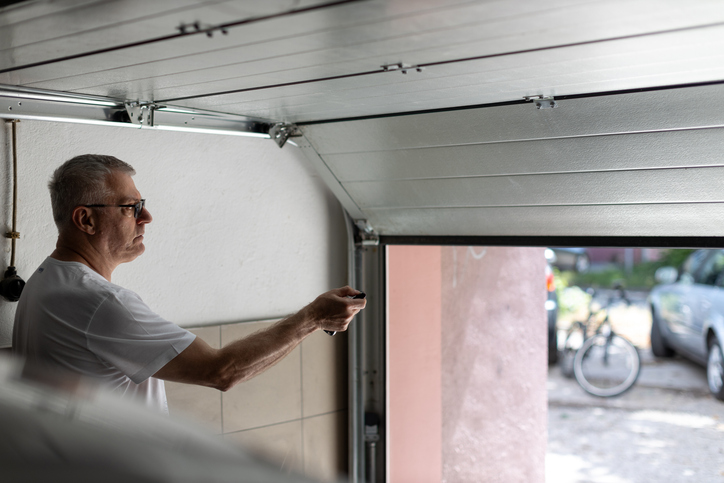
A garage door opener that hums or buzzes but doesn’t move the door is almost always an electrical problem, not a mechanical one. The most common culprit is a weak or failing start capacitor, which stores the extra charge an AC motor needs to get moving. Other causes include a tripped thermal overload inside the motor, loose or corroded wiring, and low voltage reaching the unit.
None of these are safe to diagnose by opening the motor housing yourself. If your opener is humming and not moving, unplug it and call a technician before trying again, since this kind of garage door repair involves stored electrical charge that isn’t safe to handle without training.
Key Takeaways
- A hum with zero door movement points to an electrical issue inside the opener, not the door itself.
- A weak start capacitor is the single most common cause of this symptom on AC motor openers.
- A hum that stops on its own after a few seconds often means the thermal overload tripped from overheating.
- Intermittent buzzing usually traces back to a loose or corroded wiring connection.
- Low or inconsistent voltage, often from an overloaded circuit or extension cord, causes a faint hum and weak movement.
- Continuing to press the button while the opener hums can burn out the motor. Unplug it instead.
- Routine garage door maintenance won’t fix a failing capacitor, but it does catch loose or corroding wiring before it causes intermittent buzzing.
Buzz or Hum: What the Sound Pattern Tells You
What You Hear | Likely Cause | Fix Type |
Steady hum, door doesn’t move at all | Weak or failing start capacitor | Technician (capacitor replacement) |
Hum for a few seconds, then stops | Thermal overload tripped from overheating | Cool down and retry once; call a pro if it repeats |
Buzzing that comes and goes unpredictably | Loose or corroded wiring connection | Technician (needs tracing, not guessing) |
Faint hum with slow, weak movement | Low or inconsistent voltage supply | Check outlet and circuit; electrician if it persists |
1. Weak or Failing Start Capacitor
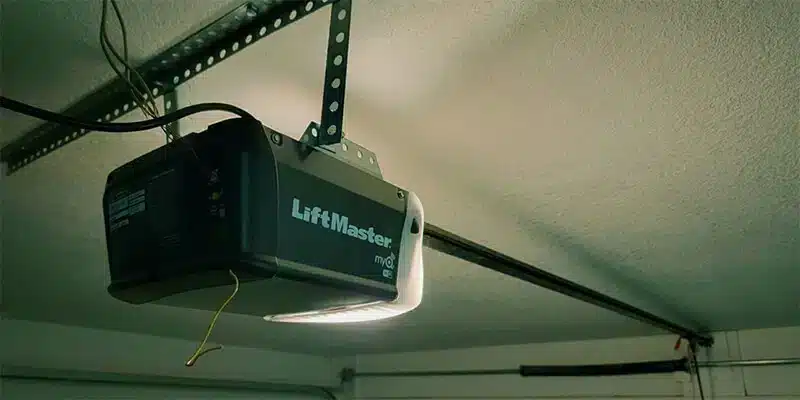
Symptom: A steady hum the moment you activate the opener, with no door movement at all, on an opener with a standard AC motor.
Most likely cause: The start capacitor gives the motor the extra push it needs to begin turning. Once it weakens with age, the motor has power but not enough force to start moving, so all that energy comes out as a hum instead of motion.
Fix steps:
- Unplug the opener rather than continuing to press the button, which can overheat a motor that’s already struggling.
- Note whether the hum is constant and immediate. That pattern points strongly to the capacitor.
- Do not open the motor housing yourself. Capacitors can hold a charge even when unplugged.
Call a pro if: The hum is immediate and constant every time you try the opener. This is one of our most common calls, and a capacitor swap is usually a quick, contained fix once a technician confirms it.
How to Fix a Weak Garage Door Opener Capacitor
Capacitor replacement is a straightforward repair for a technician, but the part carries a stored charge that makes it unsafe to handle yourself. Our rule of thumb: if the hum is immediate and the door never twitches, assume capacitor first.
If you’re not sure the noise is electrical at all, our guide on Why Is My New Garage Door Making Noise? 6 Causes and What’s Normal covers the other five causes.
2. Tripped Thermal Overload Inside the Motor
Symptom: A hum that lasts a few seconds, then stops on its own, especially after several attempts in a row or on a hot day.
Most likely cause: Most opener motors have a thermal overload switch that shuts the motor down if it senses overheating, protecting it from burning out. Repeated attempts to force a stuck or struggling door can trip this switch.
Fix steps:
- Stop trying to run the opener and let it sit unplugged for 15 to 20 minutes to cool down.
- After cooling, try one single, normal attempt. Do not repeatedly press the button.
- If it works normally after cooling, keep an eye on whether it happens again soon.
Call a pro if: The overload trips repeatedly within the same day or week. A motor that keeps overheating is usually compensating for something else, often a door that’s harder to lift than it should be.
Why a Garage Door Opener Motor Overheats and Hums
In our experience, a motor that keeps tripping its overload is rarely the root cause. It’s more often a symptom of the door being harder to lift than the motor was sized for, worth checking alongside the electrical side.
If the sound is more of a click or tick than a hum, our guide on Why Is My Garage Door Making a Clicking or Ticking Sound? 4 Causes covers that.
3. Loose, Corroded, or Damaged Wiring Connections
Symptom: Buzzing that’s inconsistent. It might work fine one time and hum the next, or the noise seems to change if you jiggle the wall control unit.
Most likely cause: Wiring connections at the motor unit, wall switch, or junction points can loosen over time or corrode, especially in a garage exposed to humidity or temperature swings. A poor connection creates resistance, which shows up as a hum instead of a clean start.
Fix steps:
- Check that the wall control unit’s wiring looks intact and isn’t visibly frayed or pinched.
- Avoid touching wiring inside the motor unit itself.
- Note exactly when the buzzing happens (every time, only in humid weather, only after jiggling a switch) since that detail helps a technician find it faster.
Call a pro if: The problem is intermittent rather than constant, since that pattern usually means a connection issue that needs to be traced, not guessed at.
How to Fix Intermittent Garage Door Opener Buzzing from Wiring
Intermittent faults are some of the hardest issues to self-diagnose since the buzzing may not be happening when you’re looking. A technician with a multimeter can trace it directly instead of replacing parts by trial and error. If wiring issues on an older opener keep recurring, Angi’s breakdown of garage door opener styles is worth a look before deciding whether to repair or replace it.
4. Low or Inconsistent Voltage Reaching the Opener
Symptom: A faint hum paired with the door moving unusually slowly or weakly, rather than not moving at all.
Most likely cause: Garage door openers need consistent voltage to run properly. Running the opener off an extension cord, an overloaded circuit shared with other high-draw appliances, or old household wiring can all starve the motor of the power it needs.
Fix steps:
- Confirm the opener is plugged directly into a wall outlet, not an extension cord.
- Check whether other appliances on the same circuit were running at the same time.
- If you have access to your electrical panel, confirm the breaker for that circuit hasn’t partially tripped.
Call a pro if: The outlet and circuit check out fine, but the weak hum continues. That points to a wiring issue further back in the circuit, which is an electrician’s job, not a garage door technician’s.
Family Handyman’s guide to installing garage door openers notes that belt-drive openers run quieter than chain-drive models, since the rubber belt doesn’t rattle the way a chain does, so a hum on a chain-drive opener isn’t necessarily a malfunction by itself. It’s the combination of the hum with little or no movement that signals a real problem.
Why Low Voltage Makes a Garage Door Opener Hum
A motor starved of power behaves like one with a weak capacitor: enough energy to hum, but not enough to overcome the door’s weight. The fix is entirely different, which is why ruling out the power supply first saves a wasted service call.
If instead of a hum you’re dealing with a hard bang, our guide on Why Does My Garage Door Bang So Hard It Shakes the Wall? 3 Close-Force and Limit Switch Causes covers that.
When Opener Humming Needs a Technician, Not a Guess
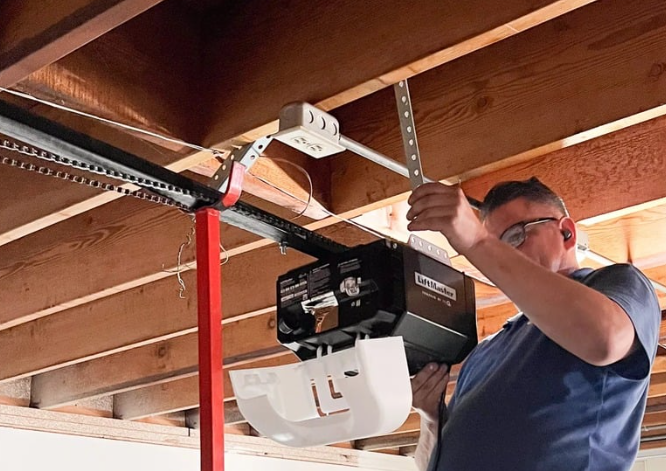
A humming opener is almost always telling you something specific: immediate and constant points to the capacitor, brief and self-stopping points to overheating, intermittent points to wiring, and faint with weak movement points to voltage.
Aloha Garage Doors services garage door openers for homeowners across Kingston, NH. If your opener is humming instead of moving, contact us today or give us a call to book a service call, and we’ll send a technician to pin down exactly which one it is.